
When a Referral May Make Sense
A referral may be appropriate when a client is facing decisions that connect money with aging, family, care, taxes, property, or legacy.
Common referral situations include:
a client nearing retirement without a clear income plan;
a widow, widower, divorcee, or newly single client who needs to reassess financial decisions;
a family worried about care costs or caregiving burden;
adult children trying to help aging parents;
clients with outdated beneficiary forms or unclear account ownership;
a client selling real estate, a business, or inherited property;
business owners thinking about retirement, succession, or liquidity;
families with sibling tension, blended-family issues, or unequal caregiving responsibilities;
clients without children or without a traditional family safety net;
clients whose estate plan, tax plan, insurance, investments, and family roles may not be coordinated.
The best referrals are not simply people with assets. They are people whose decisions require a broader planning lens.
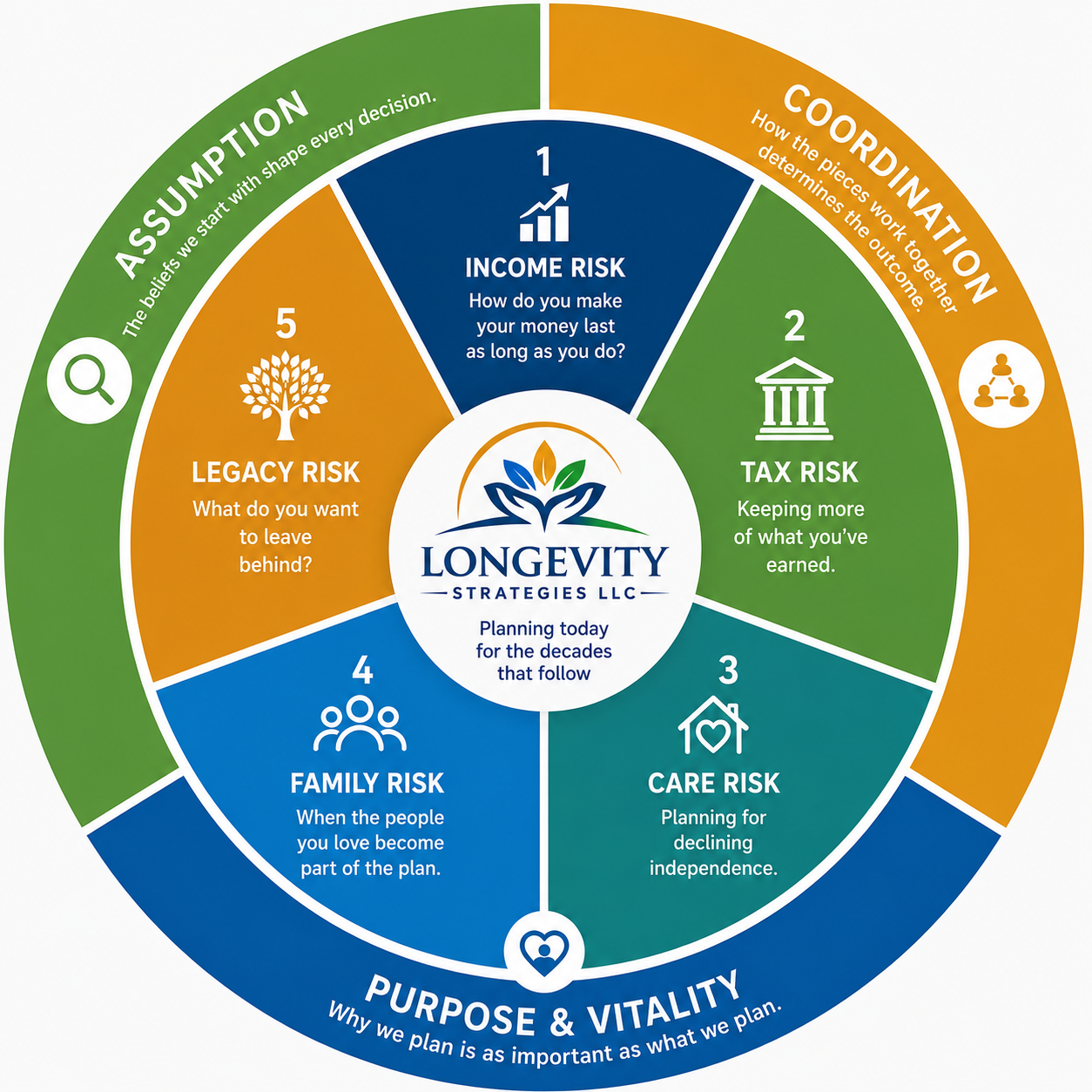
The Longevity Strategies Framework
Longevity Strategies organizes planning around five connected risks:
Income Risk — Will the client’s money support the life they want?
Tax Risk — Are tax issues being anticipated and coordinated over time?
Care Risk — How would care be paid for, delivered, and managed if health changes?
Family Risk — Will the right people know what to do, and will the burden damage relationships?
Legacy Risk — Will documents, beneficiaries, ownership, taxes, family expectations, and values work together?
The process also considers three hidden overlays:
Assumption Risk — What is the client assuming others will know, do, or agree to?
Coordination Risk — Are the pieces of the plan working together?
Purpose & Vitality Risk — Does the plan support independence, connection, contribution, and the life the client wants to preserve or build?
This framework helps clients move from vague concern to a clearer view of what may need attention.

How the Referral Process Works
The process is designed to be clear, respectful, and non-disruptive to your professional relationship.
Step 1: Professional Conversation
We begin with a brief conversation about the client situation, the planning concern, and whether Longevity Strategies may be an appropriate resource.
Step 2: Client Introduction
If appropriate, you may introduce the client directly or suggest that the client contact Longevity Strategies.
Step 3: Self-Check or Fit & Readiness Call
The client may begin with the free Longevity Readiness Self-Check or a brief Fit & Readiness Call.
Step 4: Guided Assessment
If the client appears to be a good fit, the next step may be the free Longevity Readiness Assessment™. The Assessment is educational and preliminary. It produces a readiness score and identifies possible planning gaps.
Step 5: Paid Planning Decision
If the Assessment identifies meaningful issues, the client may choose to consider a paid Longevity Risk Audit or Longevity Blueprint.
Step 6: Professional Coordination
When appropriate and authorized by the client, Longevity Strategies coordinates with the client’s attorney, CPA, care manager, realtor, business consultant, or other professional advisors.

What Longevity Strategies Does Not Do
Longevity Strategies is not a substitute for the client’s attorney, CPA, care manager, realtor, or business consultant.
The role is to help clients understand how financial planning issues connect across income, taxes, care, family, and legacy, and to coordinate with other professionals where appropriate.
Longevity Strategies does not provide legal advice, tax preparation, medical advice, real estate brokerage services, life coaching, or care management services.
A strong referral relationship respects professional boundaries.

Why Professionals Refer To Us
Our professional partners appreciate working with a financial advisor who provides the client with a clearer process without making them feel pushed into a product or investment-management conversation.
Longevity Strategies can be useful when a client needs help:
organizing financial facts before legal or tax work;
understanding retirement income and withdrawal questions;
considering care funding and family burden;
coordinating beneficiary forms, account ownership, and estate intentions;
preparing for a property sale, business transition, inheritance, or liquidity event;
identifying whether a limited planning review or comprehensive plan may be appropriate;
translating family concerns into practical planning questions.
The goal is to help the client move forward with greater clarity while strengthening, not replacing, the work of the referring professional.

Partners We Work With
Longevity Strategies welcomes professional conversations with:
estate planning attorneys;
elder law attorneys;
CPAs and tax professionals;
care managers;
realtors;
business consultants / valuation specialists;
trustees and fiduciaries;
nonprofit and charitable planning professionals;
family office and advisory professionals;
life coaches;
daily money managers;
other professionals helping clients through later-life decisions.

Common Referral Questions
Will you compete with my role?
No. Longevity Strategies does not provide legal advice, tax preparation, care management, real estate brokerage services, or business consulting. The goal is to address financial planning issues and coordinate where appropriate.
Will the client be sold a product?
We do not engage in product conversations during the Assessment or Planning processes, only if a client chooses to implement a plan with our firm. The Self-Check and Assessment are educational and preliminary. Any recommendations require a separate engagement and review of complete information.
Can we coordinate on the client’s behalf?
Yes, with the client’s permission. Coordination is often essential when income, taxes, legal documents, care planning, property, and family roles overlap.
How do you charge for the Assessment ?
We don't: it's free. The Longevity Readiness Assessment™ is not a financial plan, but an educational and preliminary analysis. If the Assessment identifies meaningful planning gaps, the client may later choose to consider a paid Longevity Risk Audit or Longevity Blueprint. Only during that process does collaborative work with other professionals occur.
What kinds of clients are the best fit?
The best fit is a client with real planning complexity, willingness to share information, and a need to coordinate income, taxes, care, family roles, or legacy decisions.
The Next Step
If you are working with a client whose financial life, family situation, care concerns, property decisions, or estate intentions may benefit from a broader planning lens, start with a professional conversation.
We can discuss the client situation at a high level, identify whether Longevity Strategies may be an appropriate resource, and decide on a respectful next step.
A brief call can help determine whether the client may be a fit for the Self-Check, a Fit & Readiness Call, or the guided Longevity Readiness Assessment™.
The Longevity Readiness Self-Check and Longevity Readiness Assessment™ are educational and preliminary. They are not financial plans, investment recommendations, tax opinions, legal opinions, insurance recommendations, health recommendations, or legal advice. Any recommendations require a separate engagement and review of complete information. Services are available only where properly licensed or registered. Professional coordination requires client authorization.